 Trendsmill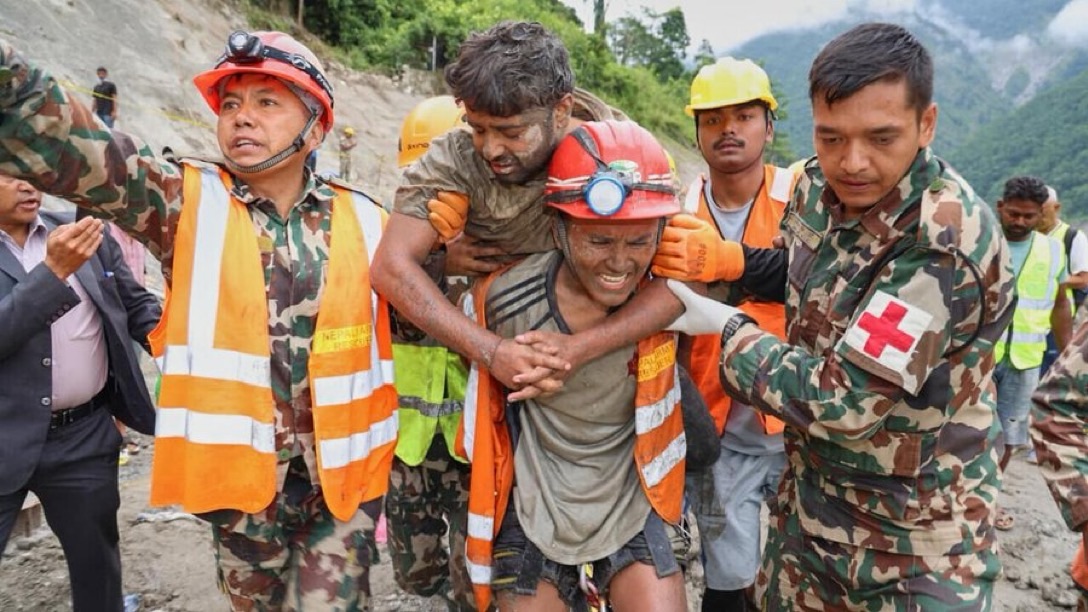
Two workers trapped inside a hydropower tunnel in Nepal have been rescued alive nine days after a glacier collapse sent a destructive wave of ice, rock and mud through the Trishuli River valley.
The men were rescued from the Upper Trishuli 3A Hydropower Station on Friday, marking the first confirmed rescue of survivors from tunnels at the hydropower projects affected by the disaster.
The workers were identified as Sanjay Sah, a mechanical foreman, and Kabir Maharjan, a mechanical supervisor.
Nepal’s Energy Ministry confirmed their rescue, while officials said both men would be taken to Kathmandu for medical treatment.
The rescue comes as authorities continue a massive search operation following the August 26 disaster.
The glacier collapse sent a large volume of ice, rock and mud through the valley, destroying homes and infrastructure and leaving thousands of people missing.
At least 1,252 people have died in Nepal, while more than 4,200 people remain missing, according to Reuters.
Thousands more people have been displaced.
Officials and rescue workers believe at least 900 people may have been trapped in tunnels connected to six hydropower projects along the Trishuli River.
The tunnels are difficult to access because the flood deposited huge amounts of mud, rocks and debris around the facilities.
Some entrances were buried, forcing rescue teams to use excavators and other heavy machinery to reach them.
At Upper Trishuli 3A, rescuers reportedly took almost six days to reach the tunnel entrance.
Rescue workers had also been supplying oxygen through pipes into possible cavities before the two men were located.
Images released by Nepali authorities showed Maharjan being pulled from an opening in the ground and placed on a stretcher.
Sah was carried from the tunnel on the back of another worker.
Army medical personnel attended to Sah at a nearby rescue tent and checked his vital signs.
An army official said his vital parameters appeared normal.
Maharjan was reported to be unable to move his hands and legs.
An aide to the energy minister said Sah’s injuries were not critical.
Both men were expected to be transferred to a hospital in Kathmandu.
The rescue has provided an important boost to ongoing operations and to relatives waiting for information about missing hydropower workers.
Amir Maharjan, the brother of Kabir, said he had heard that his brother had been found but had not yet received official confirmation when speaking to Reuters.
He said the family was happy after learning of the rescue.
Search operations are continuing at other hydropower facilities.
At Rasuwagadhi, rescue workers managed to advance approximately 250 metres into a tunnel before encountering a blockage.
Officials said efforts would continue.
A Nepal Electricity Authority official said 46 people may have been trapped in a chamber at the site.
Authorities are also searching the Chilime hydropower plant, where at least eight people were believed to be trapped, according to the Independent Power Producers’ Association of Nepal.
The rescue effort has been supported by engineers providing information about the hydropower projects and their tunnel networks.
More than 500 people are part of a WhatsApp group being used to share technical information, including tunnel layouts and drawings.
The group was established before the disaster and expanded to include additional experts after the flooding.
The disaster has also damaged Nepal’s electricity infrastructure.
The flooding wiped out an estimated 10% of the country’s power-generation capacity, adding to the humanitarian consequences of the disaster.
The scale of the destruction has made the search particularly difficult, with debris covering large sections of the valley.
Despite those challenges, rescue teams continue to search underground facilities for workers who may have survived by sheltering inside tunnels.
The rescue of Sah and Maharjan is the first confirmed breakthrough in the search for survivors at the affected hydropower projects.
Authorities are continuing the operation as families await news of those still missing.