 Trendsmill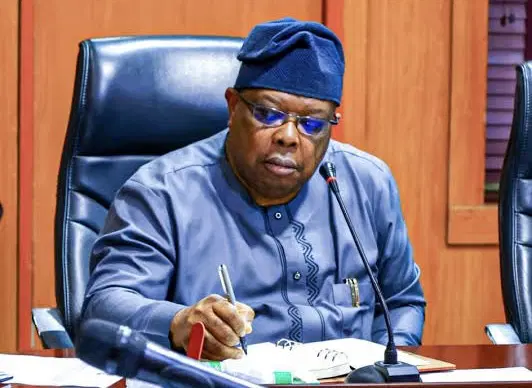
The Federal Government has dismissed reports of an impending electricity tariff increase, assuring Nigerians that its immediate priority is to improve power supply rather than raise the cost of electricity.
Joseph Tegbe, minister of power, gave the assurance on Thursday in Ibadan, Oyo State, describing reports of a planned tariff hike circulating on social media as misinformation and urging the public to disregard them.
“There is no plan to increase electricity tariffs,” Tegbe said, adding that the government was working towards a power sector capable of delivering electricity around the clock.
The minister spoke during the flag-off of a 17.7-megawatt interconnected solar mini-grid project designed to supply communities across five local government areas in Oyo State.
He said the government was pursuing a strategy to strengthen electricity generation, transmission and distribution infrastructure, with three designated energy corridors covering Lagos-Ogun, Abuja-Kaduna-Kano, and Benin-Enugu-Port Harcourt.
According to Tegbe, the plan is to improve grid stability and extend more reliable electricity supply to homes, businesses and industries across the country.
The project in Oyo State is expected to provide electricity to 22,597 customers through solar power generation supported by battery storage.
The development covers communities in Akinyele, Ido, Ibadan North, Egbeda and Lagelu local government areas, with the existing distribution infrastructure of the Ibadan Electricity Distribution Company to be used to deliver the power.
Tegbe said the initiative would help reduce dependence on petrol and diesel generators while creating better conditions for businesses, investment and employment in the beneficiary communities.
He also acknowledged the contributions of the Rural Electrification Agency, Paras Energy and Natural Resources Development Limited, the World Bank, IBEDC and the Oyo State Government to the project.
Abba Abubakar-Aliyu, managing director of the Rural Electrification Agency, said the project forms part of efforts to expand electricity access through distributed renewable energy and private-sector participation.
The mini-grid is divided among five clusters, with 1.8MW allocated to Bola, 3.5MW to Jiboye, 6.9MW to Molade-Adelubi, 3.6MW to Ogo-Oluwa and 1.9MW to Sooko-Elega.
The Olubadan of Ibadanland, Oba Rashidi Ladoja, welcomed the inclusion of rural and underserved communities in electricity interventions but urged the Oyo State Government to accelerate work on its own hybrid power project so residents could begin benefiting from improved supply before 2027.
The Federal Government’s latest assurance comes amid public concern over electricity costs and persistent complaints about unreliable supply in many parts of Nigeria.
While the minister ruled out a tariff increase, he said the government intended to strengthen the national grid and improve electricity delivery as part of its plan to achieve round-the-clock power supply.