 Oluwatosin Haruna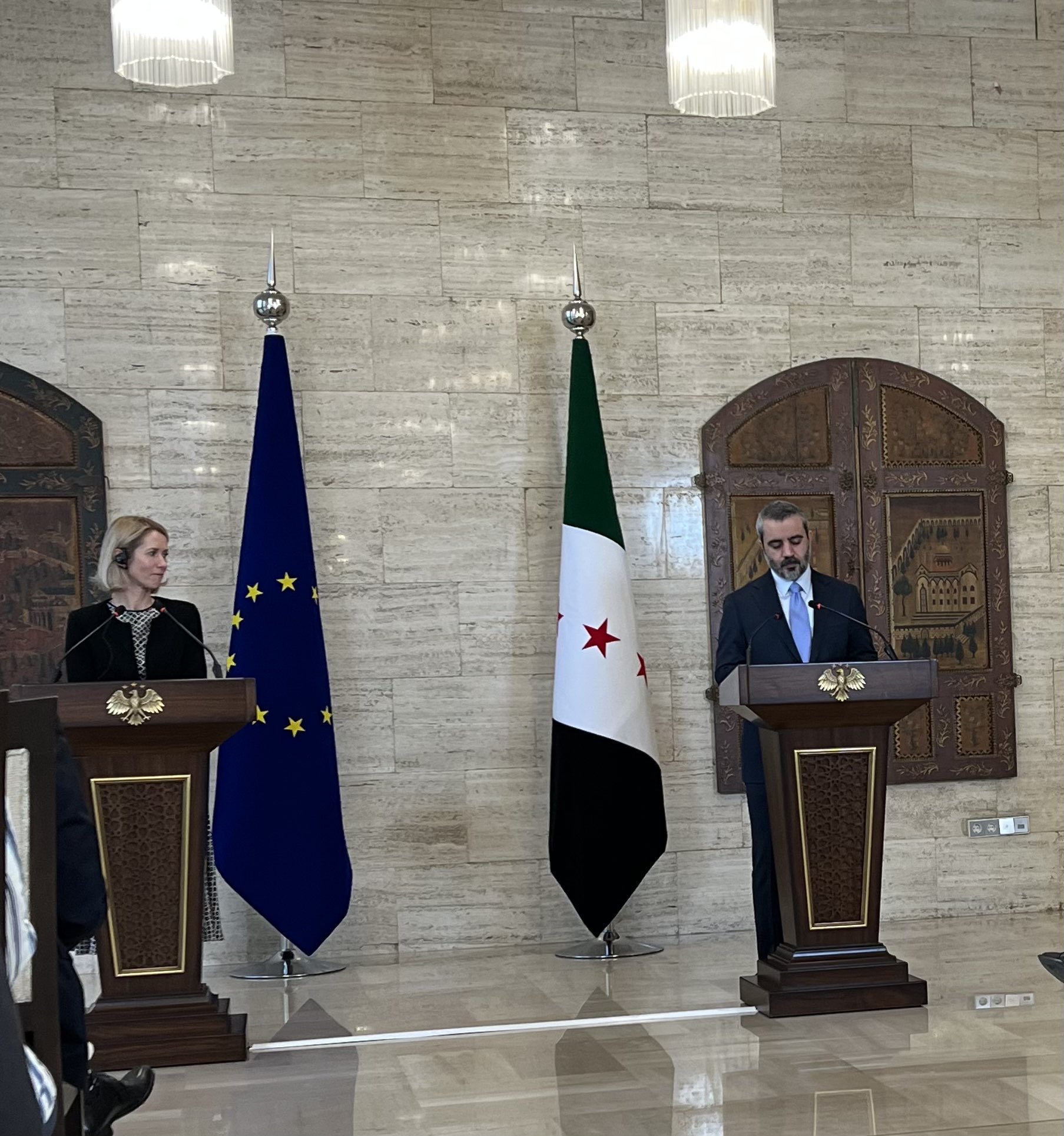

European Union foreign policy chief Kaja Kallas met Syrian Foreign Minister Asaad Hassan al-Shaibani at Tishreen Palace in Damascus on Tuesday, September 29, as the European Union expanded its engagement with Syria’s transitional authorities following the fall of Bashar al-Assad.
Confirmed by Syria’s state news agency, the meeting focused on advancing EU-Syria relations as the bloc backs Syria’s political transition and seeks to promote regional stability.
Kallas also held talks with Syrian Social Affairs and Labour Minister Hind Kabawat on social protection, sustainable development, economic and women’s empowerment, and the reintegration of returning Syrians.
The EU has allocated about €620 million for 2026 and 2027 to fund humanitarian assistance, early recovery and bilateral programmes in Syria. European officials have tied deeper cooperation to an inclusive political transition, respect for human rights and protection for all communities.
The Damascus talks followed a series of steps to restore and expand diplomatic contacts. Earlier this month, EU Ambassador Michael Ohnmacht presented his credentials to President Ahmad al-Sharaa, restoring ambassadorial-level EU representation after a gap dating to 2012.
Kallas and Shaibani had previously met on the sidelines of the United Nations General Assembly in New York before continuing their discussions in Damascus.
In May, the EU and Syria held their first high-level political dialogue in Brussels, co-chaired by Kallas and Shaibani. The talks covered bilateral relations, stabilisation, socio-economic recovery and the need for an inclusive political transition.
The meetings could mark the beginning of a more formal EU relationship with Syria’s transitional authorities, moving beyond emergency aid toward structured political and economic cooperation.
Any broader partnership is likely to remain conditional on progress in forming an inclusive government, protecting minority communities and upholding human rights, giving Brussels both an avenue to support Syria’s recovery and leverage to press its new leaders on the transition’s direction.